Your Partner for reliable greenfuel brokerage
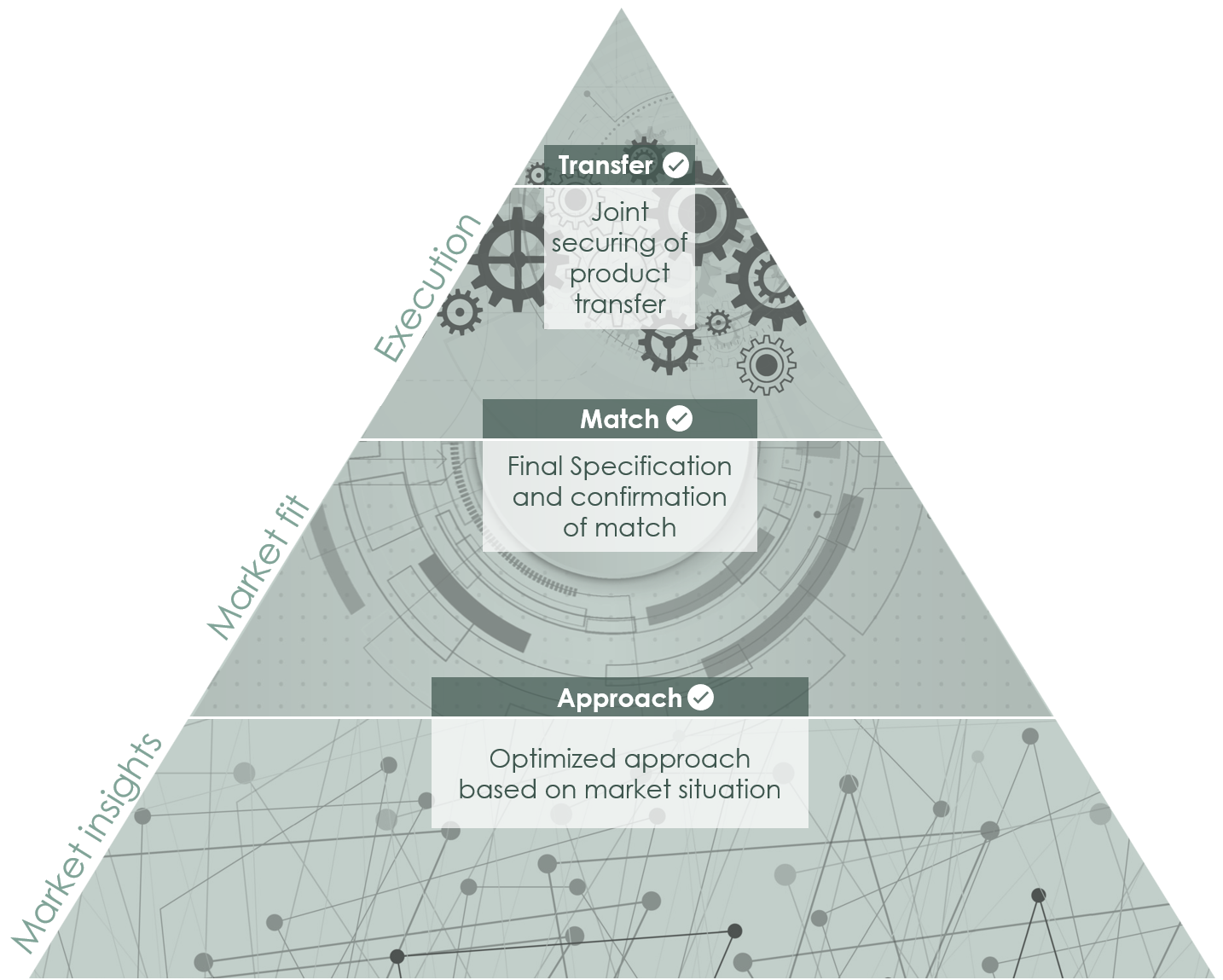
As a broker for sustainable energy sources, we see it as our responsibility to make this market more efficient, transparent and accessible. Knowledge of the current market situation, regulatory changes and new challenges facing market participants is our top priority. We are convinced that this is the basis to optimise customer results. Therefore our brokerage approach is divided into the 3 phases "Market Insights", "Market Fit" and "Realisation".
Successful biomethane commercialization requires selecting a trading structure that is optimally tailored to your specific circumstances and preferences. Attached is an overview of the key options available for commercialization
Ci-Score and feedstocks: The feedstocks used and other measures, such as CO2 capture, determine the Ci-Score and thus the quality of the biomethane. Typically, these range from +20 gCO2/MJ (waste-based feedstocks) to < – 100 gCO2/MJ (manure).
Markets: Strongly negative Ci-Scores are particularly in demand in markets driven by pure CO2 reduction targets (e.g., the German fuel market or the EU shipping sector). Waste-based biomethane with Ci-Scores between 0 and 20 gCO2/MJ are primarily used in volume-based quota markets (e.g., the British transport sector).
Fix price: A total price for Proof of Sustainability + physical gas
Index: Fixed price for the Proof of Sustainability + indexed gas price (e.g., THE, TTF)
Volume flexibility: A full-offtake or a fixed annual delivery volume with a volume flexibility of 10–15%
Spot: Sale of already-produced volumes at the current market price with direct delivery, for example, to align with the average market price over the long term.
Forward: Sales of volumes 1 to 2 years in advance, with delivery in the year of production, in order to e.g. mitigate market price risks on the spot market.
Tolling: The biomethane supplier pays a fee to the CNG/LNG station operator for putting the biomethane on the market and, in return, receives 100% of the thg-quota generated.
THG-quota share: The biomethane supplier receives a fixed percentage of the THG-quota revenue and, in return, supplies the gas station operator with biomethane.
The biomethane market has experienced great dynamics in recent years. Since regulatory requirements and quality standards have a significant impact on the target market and pricing, a nuanced analysis is essential. Attached is an overview of spot market prices for German production volumes
Note: The prices shown are for informational purposes only. greenfuelpartners GmbH assumes no liability for their accuracy or completeness.
No Data Found
The German transport sector currently offers one of the best sales opportunities for biomethane derived from manure and for e-methane through the THG-quota. Attached is a tool for calculating savings and revenues resulting from the sale of biomethane. In addition, an RFNBO sub-quota has been in effect since 2026, which can be met, for example, by selling e-methane (see RFNBO calculator)
Get the calculator as an Excel file!
Note: The results calculated by the calculators are for informational purposes only. greenfuelpartners GmbH assumes no liability for the accuracy or completeness of the results.
Transparent market situation
Current price level
Regulatory requirements
International network
Fast matching
Individual requirements
Efficient processing
Continuous support
Secured success