Your Partner for reliable greenfuel brokerage
To increase the share of climate-neutral fuels within the THG quota, the German government has set binding minimum quotas for advanced biofuels and RFNBOs. While the targets for advanced biofuels are currently feasible thanks to solid market coverage, the ambitious RFNBO quotas are still proving to be a strategic bottleneck given the current low availability.
In December 2025, the German Bundestag passed the Act on the Further Development of the Greenhouse Gas Reduction Quota (THG Quota). A key part of the Act is the introduction of binding sub-quotas/minimum quotas for the use of advanced fuels and renewable fuels of non-biological origin (RFNBOs). These are intended to ensure that certain proportions of THG reductions in the transport sector are achieved through advanced biofuels and RFNBOs. In doing so, the legislator is going beyond a purely open-ended THG quota and actively steering demand towards technologically prioritized fuels that are particularly effective in terms of climate impact. These minimum quotas define clear demand paths for the individual fuel classes and have a direct impact on the demand volumes to be expected in the future.
Definition: Biofuels according to RED III
Biofuels are fuels produced wholly or partly from biomass, such as vegetable oils, sugar, starch, waste, or residues. RED III distinguishes between conventional biofuels and advanced biofuels, the latter of which are produced from raw materials listed in Annex IX Part A (e.g., waste and residues) and are intended to avoid land use conflicts. They must meet defined sustainability criteria and greenhouse gas reduction targets in order to be eligible for the THG quota. Advanced biofuels are specifically promoted through sub-quotas in order to support technologies that have a particularly significant impact on the climate.
Definition: RFNBOs according to RED III
Renewable Fuels of Non-Biological Origin (RFNBOs) are liquid or gaseous fuels produced from renewable electricity and non-biogenic feedstocks. These include, in particular, renewable hydrogen and fuels synthesized from it, such as e-methanol or e-kerosene. According to RED III, RFNBOs must meet strict requirements for “additionality,” temporal and geographical correlation of electricity generation, and minimum greenhouse gas reduction. The “additionality requirement” under RED III ensures that the electricity used to produce RFNBOs is generated in addition to existing renewable generation capacities. The aim is to prevent existing green electricity from being withdrawn from the electricity market and indirectly replaced by fossil-fuel-based electricity. Specifically, RED III requires RFNBO producers to source their electricity from newly built renewable energy plants that are linked to RFNBO production in terms of timing and economics. This is intended to ensure real additional greenhouse gas reductions and a system-friendly expansion of renewable energies.
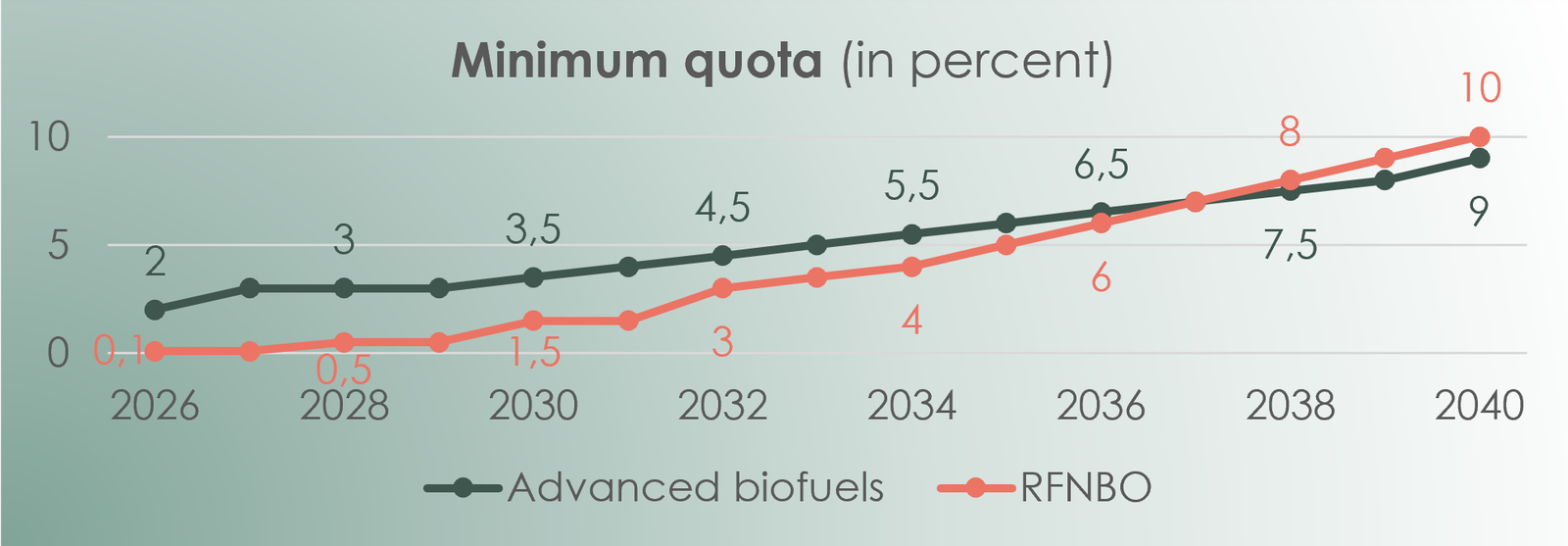
The minimum quotas in percent refer to the total amount of energy in the fuel brought onto the market by the companies subject to the quota in each compliance year. The minimum quota for advanced biofuels will gradually increase from 2% in 2026 to 9% in 2040. The quota for RFNBO will increase from 0.1% in 2026 to 4% in 2040.
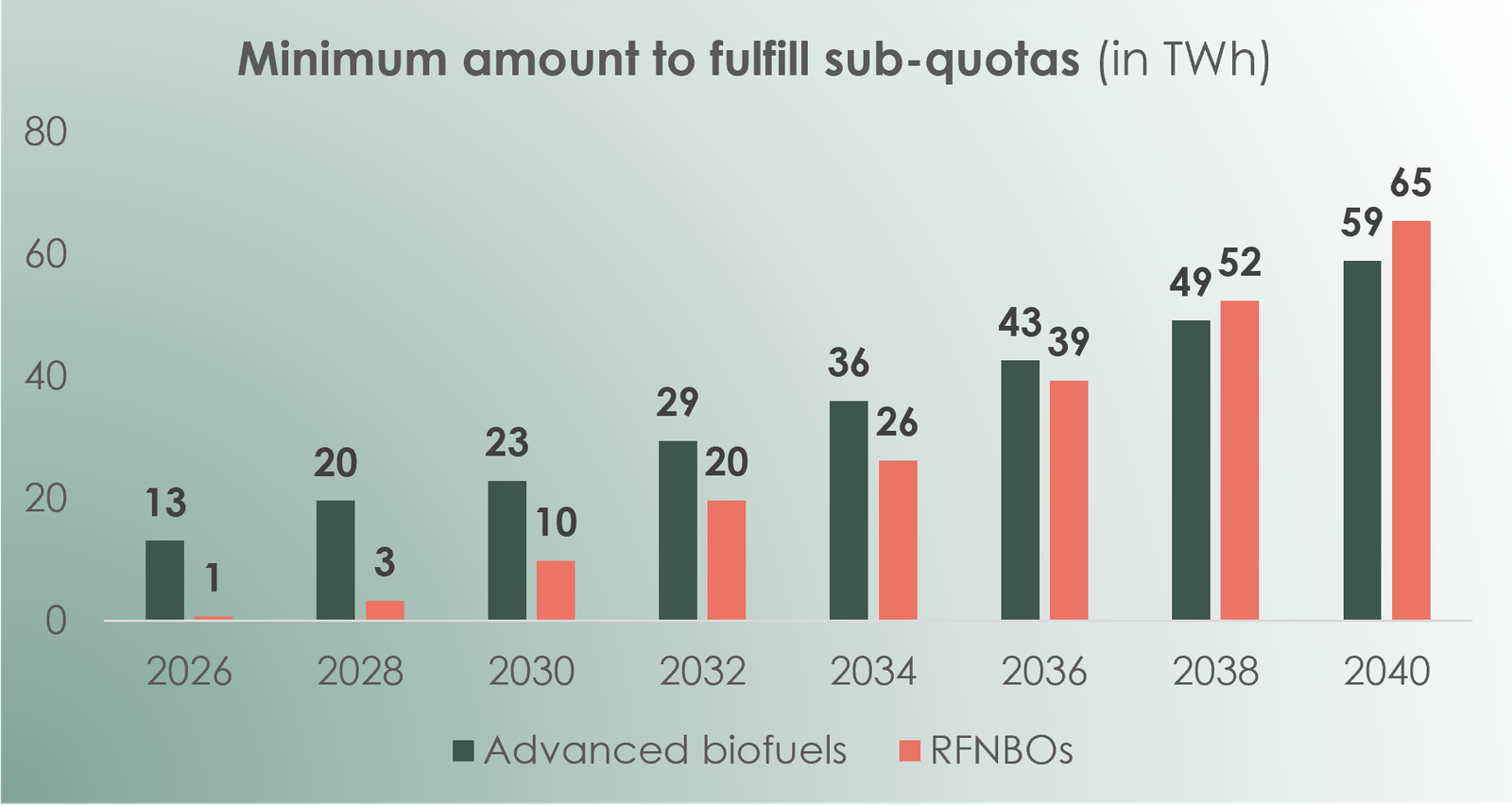
The German Customs Authority publishes annual statistics on THG quota compliance. For the last five years (2022-2024), an average total energy amount of 2,357,130,491 GJ was reported in the reference value from the THG quota1. Factors such as further electrification of the transport sector, economic growth, etc. were not considered. This energy amount serves as the basis for consideration over the next 15 years. This results in the legally prescribed minimum amounts in TWh for the use of advanced biofuels and RFNBOs. These will be necessary to meet the respective sub-quotas in the German transport sector.
The minimum amount of advanced biofuels will increase from approximately 13 TWh (~ 47 million GJ) in 2026 to almost 60 TWh (~ 212 million GJ) in 2040. Compared to the amount of advanced fuels supplied in 2024 of ~ 113 million GJ (of which ~ 27 million GJ is carried over from the previous year), it is clear that no supply shortage of advanced fuels is to be expected in the short to medium term (compared to minimum quantity of ~ 117 million GJ in 2033). It remains to be seen how the end of the inclusion of fuels from palm oil mill effluent (POME) in the THG quota will affect the availability of biofuels.
The minimum quantity of RFNBOs will increase from approximately 0.7 TWh (2,357,130 GJ) in 2026 to over 26 TWh (94,285,220 GJ). As this minimum quota will take effect for the first time in 2026, there are no reliable data points available yet. According to market participants, there is currently little to no supply on the market, meaning that companies subject to quotas are likely to find it challenging to meet this obligation. It remains to be seen to what extent a market will develop here that offers an exciting source of revenue for RFNBO projects and attracts investment to promote new projects.
Are you interested in further information on this topic? Please feel free to contact us. We look forward to talking to you!
Contact us to download the publication
greenfuelpartners GmbH
Tal 44
80331 Munich
Germany
Phone: +49 89 2096 9097
Mail: info@greenfuelpartners.com